
Primary/family care
Family medicine · Internal medicine · Pediatrics (with subspecialties) · Geriatrics · OB-GYN
Find care. Prepare well. Recover stronger.
Refuah puts everything in one place. You can compare trusted providers and book in person or by video, get evidence-based guidance to prepare for and recover from illness and treatments, see conventional, integrative and alternative options with honest evidence labels, and find nutrition and fitness support for everyday health. Plus, you get a secure space for your documents and health data.
Care for every stage of life, pediatric (0–18) and adult (18+), across every area of health.
We'll only use your email to send Refuah updates. No spam, and you can leave anytime.
Find care
Every body system. Every stage of life. Every path to healing.
Not everyone heals the same way. Some people do best with conventional medicine, some add integrative or alternative care, and some prefer a fully alternative path. Refuah lets you compare all of them, from family medicine, internal medicine, pediatrics, surgery, oncology, cardiology and the rest of Western allopathic care, to functional medicine, naturopathy, chiropractic, acupuncture, energy medicine and apothecaries/herbalists. The evidence for each one is shown plainly so you can decide with your eyes open. We never overstate what a treatment can do, and we never use fear to push you in one direction.
Every body system and every stage of life. This is the full range of specialties Refuah will list at launch.
Family medicine · Internal medicine · Pediatrics (with subspecialties) · Geriatrics · OB-GYN
Cardiology · Cardiothoracic surgery · Vascular surgery
Neurology · Neurosurgery · Pain medicine
Psychiatry · Psychology · Counseling · Therapy
Orthopedics · Sports medicine · Rheumatology · Physiatry (PM&R) · Physical therapy · Occupational therapy
Gastroenterology · Hepatology · Colorectal surgery
Pulmonology · Thoracic surgery · ENT (ear, nose & throat) · Sleep medicine
Nephrology · Urology
Endocrinology · Diabetes care
Obstetrics · Gynecology · Maternal-fetal medicine · Fertility (reproductive endocrinology)
Medical oncology · Radiation oncology · Surgical oncology · Hematology
Immunology · Allergology
Dermatology
Ophthalmology · Dentistry · Orthodontics · Holistic / natural / biological / functional-medicine dentists (self-described approach — not a regulated title) · Vision therapy (developmental & neuro-optometry)
Anesthesiology · Radiology & imaging · Preventive health · Nutrition medicine
These are the ten modalities Refuah will show at launch. Each one has an honest evidence label so you can see what's well supported, what varies, and what doesn't have much evidence behind it.
These are the types of care Refuah will list. Every provider you see at launch will be a real, verified listing. We won't invent anyone just to look bigger.
Illness touches more than the body, and for a lot of people faith is part of how they heal. If you want it, Refuah offers healing-focused scripture, the Bible app, and connections to faith communities.
Nutrition/fitness
Eating well and moving regularly help your body before and after a procedure, and every day in between. Refuah helps you find both, and every credential is labeled honestly.
Nutrition guidance for everyday health and for getting ready for (and recovering from) a procedure. You're matched with providers who list exactly the credentials they hold.
“Registered dietitian” is a regulated credential. “Nutritionist” is a broader title that isn't regulated. We show you exactly which one a provider holds.
Personal trainers and gyms for strength, mobility and everyday fitness. Think of it as something that works alongside your care, not in place of it.
Wellness and fitness support your care. They are not a substitute for medical treatment.
Clinical trials
Refuah searches the official ClinicalTrials.gov registry live. That's the clinical studies database run by the U.S. National Institutes of Health, so what you see is current and real. Type in a condition and look through what's actually listed.
Clinical trial listings are information, not medical advice. Trials have strict eligibility rules and real risks, so always talk with your care team about whether a trial might be right for you before you consider joining one.
Type a condition above to see real, current trials from the official ClinicalTrials.gov registry.
Community/support
Wherever you are in your health journey, you don't have to walk through it alone. Below are verified organizations, national nonprofits and South Florida groups, that help people find support, encouragement and community. We checked every one of them before publishing, and we only link to their official sites.
Organizations marked “national” serve people all over the U.S. Local ones serve Miami-Dade and the rest of South Florida. Each description comes from the organization's own public mission.
A national nonprofit that removes the financial and system barriers that keep people from eating-disorder treatment, and connects people in recovery with support.
Visit the official siteThe official NAMI affiliate for Miami-Dade and Monroe counties, offering mental-health support, education and advocacy.
Visit the official siteA cancer-support community in South Florida with support groups, education and connection for anyone touched by cancer.
Visit the official siteA Miami nonprofit in the national Cancer Support Community network that offers cancer support and community programs.
Visit the official siteA national nonprofit that supports families and friends after the death of a child, with local chapters across the U.S.
Visit the official siteA national nonprofit that supports family caregivers with resources, tools and a community of people going through the same thing.
Visit the official siteA Miami-Dade human services agency offering counseling, care coordination and support programs for all ages.
Visit the official siteVerified 2026-09-11 against each organization's official website or public nonprofit registry. Programs and availability change, so always confirm details with the organization directly.
For a lot of people, faith is part of healing. Refuah will make it easy to find mental and behavioral care where faith matters: state-licensed psychologists and licensed counselors who identify as Christian or faith-based, plus Christian counseling organizations. This page lists verified organizations only. Individual practitioners will show up in our provider directory, and every listing there comes from a verified registry or the practitioner's own claim. We never list an individual we haven't verified.
A professional membership association for Christian counselors, with training, resources and a counselor directory.
Visit the official siteA Christian counseling ministry with resources, training, and a directory of certified counselors.
Visit the official siteA national Christian ministry with counseling resources and referrals for families.
Visit the official sitePractitioners only appear from verified sources: public license registries (Tier 1) or a provider's own verified claim (Tier 2). No individual practitioner shows up on this page, or anywhere else, without verification.
Licensed psychologist and licensed counselor (LMHC) are titles regulated by the state, and you can check them through state licensing boards. Pastoral counselor usually isn't a state-licensed title. When a pastoral counselor does hold a license, that comes from a separate state credential. Always check the license behind the title.
Organization-level listings only. We don't name individual practitioners here.
Spiritual care
Illness touches more than the body, and for a lot of people faith is part of how they heal. If you want it, Refuah offers healing-focused scripture, the Bible app, and connections to faith communities.
For many people, faith is part of healing, and we're glad to walk that part with you.
Every verse here comes from the English Standard Version. You can keep reading around it, in hundreds of translations, for free in the YouVersion Bible app.
Open the Bible appChurches and synagogues across Christian denominations, Hebrew Roots and Jewish congregations. A place where your faith is welcomed as part of your healing. This is coming to Refuah soon. Until then, these directories can help:
Hebrew Roots congregations: a Refuah directory is coming soon. We won't send you to listings we can't verify.
Congregations we could confirm in a public record, listed with the source we checked.
Esperanza Mision Casa De Israel Inc
Homestead, Florida (Miami area)
A registered religious congregation, recorded with the IRS as a 501(c)(3) religious organization since 2019.
View the public recordWe only add a congregation when we can point to a real public record for it, and we link that record here so you can check it yourself.
“But he was pierced for our transgressions; he was crushed for our iniquities; upon him was the chastisement that brought us peace, and with his wounds we are healed.”
Isaiah 53:5 — ESV
“He himself bore our sins in his body on the tree, that we might die to sin and live to righteousness. By his wounds you have been healed.”
1 Peter 2:24 — ESV
“Heal me, O Lord, and I shall be healed; save me, and I shall be saved, for you are my praise.”
Jeremiah 17:14 — ESV
“He heals the brokenhearted and binds up their wounds.”
Psalm 147:3 — ESV
“A joyful heart is good medicine, but a crushed spirit dries up the bones.”
Proverbs 17:22 — ESV
Prepare/recover
A growing body of peer-reviewed research points to safe, practical ways to help your body handle surgery and anesthesia. Before, that means gentle movement in the weeks leading up (as your care team advises), good nutrition, staying hydrated, and quitting smoking well ahead of time. After, it means following your recovery plan, moving gently as advised, and protecting your sleep and nutrition so you can get back on your feet.
A randomized trial of 77 people having colorectal surgery for cancer compared exercise, nutrition counselling and relaxation that started four weeks before surgery (prehabilitation) with the same programme started right after surgery. While they waited for surgery, functional walking capacity improved in 53% of the prehabilitation group versus 15% of the other group, and eight weeks later more of the prehabilitation group had recovered or passed their starting level. Complication rates and hospital stay were similar, and this was a single small trial, so what it shows is better physical function, not fewer complications.
View the study in PubMedA Cochrane review pooled the trials of nutrition given before gastrointestinal surgery. In six trials, immune-enhancing formulas reduced total postoperative complications, and in three smaller trials parenteral nutrition reduced complications in people who were already malnourished. Standard oral supplements and tube feeding showed no clear difference, and the authors warned that bias and older treatment routines limit how far the results apply today. A 2024 Cochrane update (Sowerbutts and colleagues, 2024) found the newer evidence too uncertain to settle the question, with a signal that standard oral supplements may reduce infections in people who are already losing weight.
View the study in PubMedA Cochrane review of 13 trials with 2,010 smokers found that support to quit before surgery increases the chance of not smoking at the time of surgery. Brief advice helped modestly, while the two intensive programmes, which began four to eight weeks before surgery with weekly counselling and nicotine replacement, showed much larger effects, and those same two trials also found fewer complications and fewer wound problems. The review notes that the complication evidence comes from a small number of trials, and the best intensity of support is still unknown.
View the study in PubMedA meta-analysis of six randomized trials with 452 patients compared enhanced recovery pathways, which combine small steps such as a carbohydrate drink before surgery, avoiding long fasting, and eating and moving soon afterwards, with conventional care in open colorectal surgery. Hospital stay was about two and a half days shorter and complications were roughly halved in the enhanced recovery groups, with no increase in readmissions or deaths. The trials were small and the review dates from 2010; enhanced recovery has since become standard in many hospitals and later guidelines have adapted it to other operations.
View the study in PubMedEach citation links to its official record in PubMed, from the U.S. National Library of Medicine. We summarize what each study found, and when later research added context, we say so.
One platform, five pillars
Refuah is built on five promises: find the right care for every age, prepare for it with confidence, see every option with honest evidence, support your body with nutrition and movement, and make room for faith if you want it.
Compare trusted providers side by side (specialties, availability and patient reviews) and then book in-person or telehealth visits in one place. Care for every stage of life, with age-appropriate options across every area of health.
Science-based guidance for getting ready for and recovering from any surgery or anesthesia, built on current peer-reviewed evidence and written in plain language.
The full range of conventional Western (allopathic) care, from family medicine, internal medicine and pediatrics to surgery, oncology and cardiology, next to functional medicine, naturopathy, chiropractic, acupuncture, energy medicine and apothecaries/herbalists. Every path is shown openly, with honest evidence labels.
Healing-focused scripture with accurate citations, the Bible app right there, and connections to faith communities. For many people faith is part of healing, and we're glad to walk that part with you.
Nutrition specialists and registered dietitians, plus personal trainers and gyms, for everyday health and for getting ready for and recovering from procedures. We're honest that this is wellness that supports your care.
How it works
Simple on purpose. You're in control the whole way.
Share your condition, procedure or preference. That's all it takes to see your options.
See providers and care paths side by side, with credentials, availability and honest evidence labels.
Pick the visit that fits your life and schedule it in one place. No jumping from portal to portal.
Coming soonFollow evidence-based guidance before and after, and stay connected with your care team.
The science of connection
Why do some people recover better than others? Part of the answer is the people around them. Warm relationships and social connection are tied to how well our bodies handle stress and recover, and a growing body of peer-reviewed research backs that up. Here's what the evidence actually shows, summarized accurately and without overclaiming.
A meta-analysis that pooled 148 studies found that people with stronger social relationships had a lower risk of dying early, and the size of that link was comparable to well-known risk factors like smoking. It shows an association across many studies. It doesn't claim any one relationship guarantees a longer life.
View the study in PubMedIn a controlled experiment, healthy adults with more diverse social ties were less likely to catch a cold after being exposed to a cold virus, and that link held even after accounting for age, health habits and other factors.
View the study in PubMedIn a controlled study of a small standard wound, caregivers under long-term stress healed much more slowly than matched controls, and their immune cells were less active. A lab follow-up (Marucha et al., 1998) found the same effect from exam stress in dental students.
View the study in PubMedThis randomized study reported that women with metastatic breast cancer who were in a support group lived longer than the control group. Later, larger reviews haven't consistently confirmed a survival benefit. However, the emotional and quality-of-life benefits of support groups are well documented, so we show the study with that context.
View the study in PubMedA review of how feeling isolated might affect the body over time. Higher blood pressure, poor sleep and changes in stress hormones are some of the possible pathways it describes, not settled conclusions.
View the study in PubMedA landmark review that pulled together the early evidence linking relationships to health and argued the link deserved as much attention as smoking, blood pressure and cholesterol. It laid the foundation for the field.
View the study in PubMedConnection supports healing. It doesn't replace medical care, it's part of the whole picture. Prepare for your procedure with your care team's guidance, and let the people who love you walk through it with you. That's the emotional side of prepare and recover.
Each citation links to its official record in PubMed, from the U.S. National Library of Medicine. We summarize what each study found, and when later research added context, we say so.
Integrative/alternative options
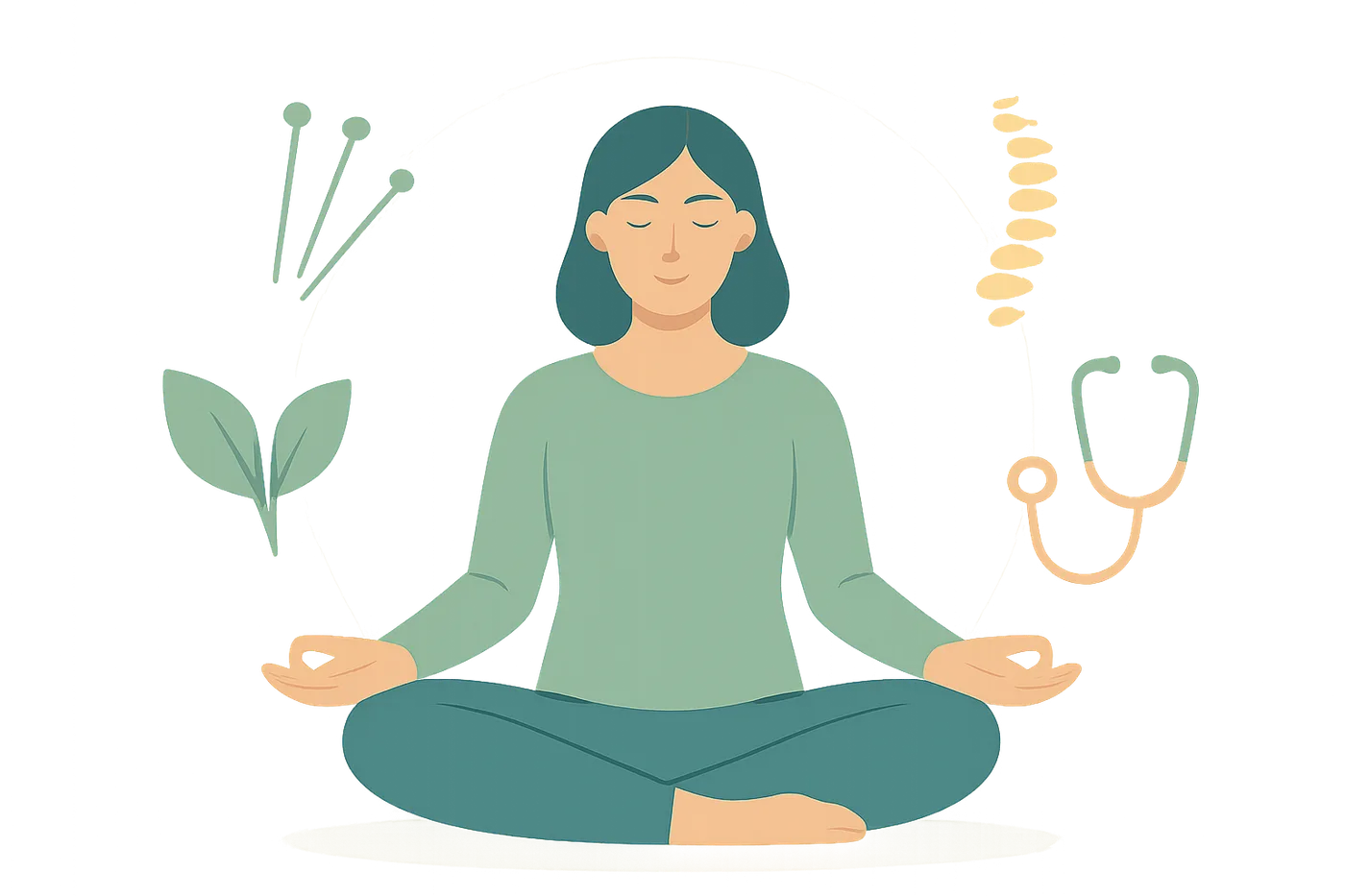
Not everyone heals the same way. Some people do best with conventional medicine, some add integrative or alternative care, and some prefer a fully alternative path. Refuah lets you compare all of them, with the evidence for each one shown plainly, so you can decide with your eyes open. We never overstate what a treatment can do, and we never use fear to push you.
Looks for root causes across lifestyle, environment and body systems.
Combines nutrition, lifestyle, botanical medicine and other therapies.
Focuses on the musculoskeletal system, especially the spine.
Very thin needles placed at specific points, often used for pain and nausea.
Therapies based on balancing the body's energy fields.
Herbal and plant-based preparations, often made for one specific person.
Very diluted preparations chosen based on a person's symptoms. Most uses aren't supported by modern studies, and we show it so you have the full picture.
Hands-on work on muscles and soft tissue, often used for relaxation, stress and some kinds of pain.
Osteopathic physicians (DOs) are fully licensed doctors who also use hands-on osteopathic manipulative treatment.
Midwives give pregnancy, birth and postpartum care in hospitals, birth centers and homes.
Wellness and aesthetics businesses we could confirm in a public record. They're listed with the source we checked, and as businesses, not licensed practitioners.
Relive Health Coral Gables
Coral Gables, Florida (Miami area)A wellness and anti-aging center that says it offers lab testing, hormone therapy for men and women, IV vitamin therapy, medical weight loss, peptide and ozone therapy, and medical aesthetics (neurotoxins, dermal filler, microneedling).
View their pageThese are businesses, not licensed practitioners. We publish what the business says about its own services and contact details, and we link its page so you can check it. Nothing here is a Refuah endorsement, and we're not implying any treatment claim or result.
Food/gyms
Find them by city. Know what they cost.
Eating well and moving well are everyday wellness. They support your health and your care, but they're different from medical treatment. Refuah's food and gym tools show real options with real prices, described honestly.
Find restaurants that cook with whole foods (no seed oils, organic produce, organic coffee), described exactly how they are on the menu and searchable by city and state.
Menus are described honestly. We don't invent dishes or ingredients, and listings come from real, verified business data at launch.
Search by gym, state and city and see real membership prices before you go. No more “call for pricing” surprises.
Prices come from real, verified business data and are kept as accurate as the source allows, searchable across all 50 states. We never publish made-up numbers.
Farm stores and farm-fresh food shops we could confirm in a public record, listed with the source we checked.
Hubbard's Cupboard
Miami, Florida (33161, NE 125th St corridor)A farm store whose own listing describes farm-fresh, regenerative groceries: raw dairy (A2A2 yogurt, kefir, ice cream), pasture-raised meats and chicken, and house-made yogurt.
View the public listingWe only add a store when we can point to a real public record for it, and we link what we checked (the store's own listing or page) so you can see it yourself. We don't publish a street address unless the business does, and we never make up a menu, price or certification.
Products we recommend
When we recommend something, it's because we believe in it, not because someone paid us to say so. Every recommendation here is editorial: we think it through, describe it honestly, and tell you clearly if a link ever earns Refuah a commission.
Check back soon. We're building this list carefully, and when products show up here, they'll be ones we really believe in, with honest descriptions and clear disclosures. No products yet and no filler, just a promise of what's coming as Refuah grows.
Affiliate disclosure: When product links appear on this page, some may be affiliate links. If you buy through one, Refuah may earn a small commission at no extra cost to you. Commissions never change what we recommend, and we only mention products we believe in. There are no product links here today. This disclosure applies from the moment the first one shows up.
Health decisions deserve honesty. That's the rule Refuah is built on.
Every health claim on Refuah has to trace back to current peer-reviewed evidence. If it can't, it doesn't go up.
Conventional Western (allopathic) medicine and integrative/alternative options each show their real evidence status. Some are well supported for specific uses and some aren't, and you'll see the difference. Regulated credentials like “registered dietitian” are shown exactly as they are, next to unregulated titles like “nutritionist.”
We show you the options and the evidence. You and your care team make the decisions together.
Join the waitlist
Early access, product updates and launch news, straight to your inbox. No spam, no pressure, and you can leave anytime.
We'll only use your email to send Refuah updates. No spam, and you can leave anytime.
My Refuah
Your documents, your numbers and your symptoms, all in one secure space that keeps you and your care team on the same page.
Upload documents, ID, insurance and card information, and anything your appointment asks for. It's stored securely and ready when you need it.
Log your numbers (blood pressure, labs, weight) and write down how you feel: pain, headaches, weakness in one area, and more. You'll see if things are getting better or worse at a glance, so you and your care team stay on the same page.
Specialties, experience, availability and patient reviews in one clear view.
See which insurers each provider takes before you book, and filter results by your own coverage. No more calling around to find out.
Providers who publish their rates can show self-pay and out-of-pocket costs up front. When the price depends on insurance, you'll get clear estimates, always labeled as estimates.
Book the visit that works for you, in person or by video, without juggling apps and portals.
Step-by-step, evidence-based guidance for before and after surgery or anesthesia, for every type of procedure.
Every care path, conventional or alternative, shows what the evidence supports and what it doesn't.
Conventional Western (allopathic) care, from family medicine and pediatrics to surgery and oncology, side by side with functional medicine, naturopathy, chiropractic, acupuncture, energy medicine and apothecaries/herbalists.
Healing-focused scripture with accurate citations, the Bible app right there, and faith-community connections across Christian, Hebrew Roots and Jewish traditions.
Appointments, guidance, records, documents and health numbers, together in one secure place.
Learn
A reading list for your health journey, sorted by theme. It goes from evidence-based medicine and surgeons' memoirs to herbal traditions, nutrition, and books whose claims sit outside mainstream consensus (those are clearly labeled as the author's views). Every title here is a real book we checked against library records. We only list what we can verify, and we describe honestly what we find.
Marty Makary, MD
A surgeon looks at the hidden incentives that bias medical decisions, and the changes that can reduce harm, from decision-support tools to more transparency in medicine.
View the library recordMarty Makary, MD
A surgeon's account of what goes wrong in modern medicine (hidden errors, conflicts of interest and the systems that let them happen) and his ideas for fixing it.
View the library recordAtul Gawande, MD
A surgeon's compassionate look at aging and end-of-life care, how medicine often drags out suffering, and how honest conversations about what matters most can bring dignity back to our last years.
View the library recordJoshua Mezrich
A transplant surgeon's memoir from the operating room about death, organ donation, and the science/humanity behind one of medicine's most dramatic lifesaving procedures.
View the library recordPaul Kalanithi, MD
A neurosurgeon's memoir of facing his own terminal diagnosis and asking what makes life meaningful when time runs out. A powerful reflection on mortality and medicine.
View the library recordRahul Jandial
A neurosurgeon's practical lessons on protecting your brain, from sleep, nutrition and exercise to stress and learning, based on his years in the operating room.
View the library recordDaniel Goleman, PhD
The landmark book that brought emotional intelligence to everyday readers. It shows how self-awareness, self-control and empathy shape success, relationships and well-being, based on decades of psychology research.
View the library recordBrené Brown
A researcher's look at vulnerability, courage and shame, based on years of qualitative studies, and how showing up fully makes connection and resilience stronger.
View the library recordBessel van der Kolk
A psychiatrist's account of how trauma shapes the brain and body, and the treatments used to help people recover: sensory, relational and body-based approaches alongside talk therapy.
View the library recordDavid D. Burns, MD
The classic self-help guide to cognitive behavioral therapy for depression and anxiety, with concrete ways to spot and change negative thought patterns, written for everyday readers.
View the library recordJohann Hari
A journalist investigates the causes of depression and anxiety, from loneliness and disconnection to trauma and modern work, and the social/practical solutions people have found.
View the library recordSarah E. Hill, PhD
A psychologist explains how hormonal birth control can affect the brain, mood, attraction and stress responses, summarizing the research on women's hormonal biology.
View the library recordPhilip Yancey
A thoughtful look at suffering and faith for people wrestling with pain and asking where God is in it. For anyone who finds strength and comfort in Christian faith.
View the library recordConrad W. Baars, MD
A Catholic psychiatrist's guide to understanding emotions and the role they play in psychological healing, written from a faith-informed view of the whole person.
View the library recordConrad W. Baars, MD
A Catholic psychiatrist's study of emotional deprivation disorder (the human need to feel affirmed) and his approach to healing it.
View the library recordConrad W. Baars, MD
A look at human affirmation, and how being truly received and accepted shapes our ability to love, grow and heal emotionally.
View the library recordDr. Ann Shippy
A functional-medicine physician's science-backed guide to getting healthy before pregnancy (nutrition, detoxification and hormone balance) and carrying that foundation into pregnancy and after birth.
View the library recordLily Nichols
A registered dietitian's evidence-based guide to prenatal nutrition, with research citations throughout. A practical resource for eating well before and during pregnancy.
View the library recordEmily Oster
An economist's data-driven approach to pregnancy decisions, from caffeine to tests and interventions, weighing what the research actually shows. It's a decision-support read, so always talk your choices through with your care team.
View the library recordDave & Lana Asprey
Two parents' guide to improving diet and lifestyle before and during pregnancy (nutrition, supplements and environmental choices) written for expecting parents.
View the library recordPeter Attia, MD
A physician's practical framework for extending healthspan, meaning the years you live in good health. It's built around exercise, nutrition, sleep and emotional health, with the evidence for each laid out plainly.
View the library recordDavid A. Sinclair, PhD
A Harvard geneticist explains the science of aging, including his own lab's research, and argues that aging itself can be slowed or treated. A research-forward view, not a promise.
View the library recordMatthew Walker, PhD
A neuroscientist sums up the sleep research: what sleep does for memory, immunity and healing, and what happens when we don't get enough. An easy way into why rest is part of recovery.
View the library recordMichael Greger, MD
A physician walks through the leading causes of death and the diet evidence around each one, with practical food recommendations. It teaches nutrition and disease prevention, but it's not a substitute for medical care.
View the library recordMichael Pollan
A journalist traces four meals from field to plate to show where our food comes from, and what our food choices cost us, our communities and the planet.
View the library recordDana Cohen, MD & Gina Bria
A functional-medicine physician and a hydration researcher make the case for replenishing water and electrolytes (including “gel water” in plants) to support energy and health.
View the library recordSally K. Norton
A health educator argues that high-oxalate “superfoods” may harm sensitive people. These are the author's claims and they aren't established in mainstream nutrition science. Shown for completeness, not as medical advice.
View the library recordMorley Robbins
A mineral-research author's framework that treats fatigue as a root-cause problem of mineral and metabolic imbalance, including his claims about magnesium, copper and iron and their role in energy. These are the author's claims and they aren't established in mainstream medicine. Shown for completeness, not as medical advice.
View the library recordBill Schindler
An archaeologist's guide to eating the way our ancestors did (fermentation, whole foods and traditional food prep) with practical techniques for a modern kitchen.
View the library recordWilliam Campbell Douglass II, MD
A physician's case for raw milk over pasteurized milk. His claims about raw milk's safety and benefits aren't supported by mainstream food-safety and medical consensus. Shown for completeness.
View the library recordWilliam Campbell Douglass II
A companion to The Milk Book that argues for raw over pasteurized dairy. The author's claims conflict with mainstream food-safety guidance. Listed for completeness, not as health advice.
View the library recordSally Fallon Morell with Mary G. Enig
A traditional-foods cookbook built around fermenting, soaking, sprouting and bone broths, a practical guide to whole-food cooking. The authors' bigger health claims come from traditional diets rather than mainstream nutrition science, so it's included as a cooking resource, not medical advice.
View the library recordHilary Boynton and Mary Brackett
Nutrient-dense recipes built around the GAPS diet, the authors' gut-focused eating plan. GAPS isn't established in mainstream clinical evidence, so the book is included as a recipe resource, not medical guidance.
View the library recordTed J. Kaptchuk
The classic English introduction to traditional Chinese medicine (its ideas of qi, yin and yang, and how it diagnoses) by a Harvard researcher.
View the library recordHarriet Beinfield & Efrem Korngold
A practitioner's guide to Chinese medicine as a way of life, covering the five elements, diagnosis, and herbal/dietary treatments, written for Western readers.
View the library recordDan Bensky & Andrew Gamble
The standard English reference on Chinese herbal formulas and individual herbs (their properties, uses and preparation) used in clinics and classrooms.
View the library recordJosh Axe
A doctor of natural medicine's guide to traditional remedies for common problems (herbs, foods and lifestyle habits from ancient healing systems) with modern cautions.
View the library recordJethro Kloss
A classic of the natural-health movement, with herbs, diet and home remedies compiled in 1939. It's a historical text and some claims are outdated by modern evidence, so it's listed for its place in natural medicine's history.
View the library recordPhyllis D. Light
A fourth-generation herbalist's account of Southern Appalachian folk healing (plant remedies, rootwork and the traditions behind them) told as a living cultural practice.
View the library recordDavid Winston & Steven Maimes
An herbalist's reference on adaptogenic herbs, their traditional uses and how to prepare them. Note: mainstream medicine doesn't accept “adaptogen” as a scientific category.
View the library recordRosalee de la Forêt & Emily Han
A practical guide to foraging and making herbal remedies from common wild plants (teas, salves, tinctures and foods) with plant ID and safety notes.
View the library recordHildegard of Bingen
The 12th-century abbess's encyclopedia of plants, animals and minerals and their medicinal uses, in a 1998 English translation. It's a historical work of natural philosophy, not modern medical guidance.
View the library recordRosemary Gladstar
A much-loved herbal teacher's friendly introduction to growing, harvesting and preparing common healing herbs: teas, salves and tinctures for everyday wellness.
View the library recordRosemary Gladstar
Practical recipes for teas, tonics, oils, salves and tinctures from one of America's best-known herbalists. A hands-on reference for home.
View the library recordRosemary Gladstar
A guide to using herbs for the whole family, from everyday remedies to long-term health habits, by a leading modern herbalist.
View the library recordLeigh Erin Connealy, MD
An integrative-medicine physician's program of diet, supplements and lifestyle for cancer prevention and support. This is her approach, so follow your oncology team's guidance for treatment decisions.
View the library recordStephen Hussey, DC, PhD
A chiropractic physician's alternative framework for heart health. His views on diet, exercise and cardiac care differ in places from mainstream cardiology. This is the author's view, so talk it over with your cardiologist.
View the library recordStephen Hussey, DC, PhD
A chiropractic physician looks at inflammation as the common thread of chronic disease, with his framework for diet and lifestyle change. The author's view, shown for completeness.
View the library recordStephen Hussey
A self-published guide by a chiropractic physician and health author who proposes that chronic pain can be understood and worked with through human physiology. His view differs in places from conventional pain medicine, so talk it over with your clinician.
View the library recordThomas Cowan, MD
A physician's theory that cancer is tied to how water behaves in the body rather than only genetic mutation. The author's claims aren't supported by mainstream oncology. Shown for completeness.
View the library recordSamuel Hahnemann
The founding text of homeopathy, first published in 1810, which lays out the “like cures like” idea. Mainstream medical evidence doesn't support homeopathy's effectiveness. This is its historical source.
View the library recordStephen Cummings & Dana Ullman
A guide for everyday readers on treating common problems at home with homeopathic remedies. Mainstream clinical evidence hasn't established these remedies as effective. Listed for completeness.
View the library recordMaesimund B. Panos
A guide to homeopathic first aid and everyday remedies. It presents homeopathy's claims, which mainstream evidence doesn't support for treating illness. Shown for completeness.
View the library recordChildren's Health Defense
A vaccine-safety advocacy group's critique of the U.S. vaccine program. The authors' claims differ from mainstream medical consensus on vaccine safety and effectiveness. Shown for completeness, not as medical guidance.
View the library recordRobert F. Kennedy Jr. & Brian Hooker, PhD
A comparison of health outcomes in vaccinated and unvaccinated children by vaccine-skeptical authors. The findings are the authors' own and conflict with the scientific consensus on vaccine safety. Listed for completeness.
View the library recordSuzanne Humphries, MD & Roman Bystrianyk
A physician and a researcher argue that vaccines didn't cause the historic drop in deaths from infectious disease. Their claims conflict with mainstream medical and epidemiological evidence. Shown for completeness.
View the library recordA few titles on this list make claims that mainstream medical evidence doesn't support. Those are labeled as the author's views and shown for completeness, never as medical guidance. For any health decision, talk with your care team.
Why Refuah exists
The Refuah logo brings together two Hebrew letters, Resh (ר) and Samech (ס). Resh is connected to the head and stands for direction, awareness and renewal. Samech comes from the Hebrew root that means to support, sustain or uphold, and it stands for the care and stability that surround us while we heal.
Woven together, the two letters show what health means to Refuah: supporting the whole person on the way to healing, renewal and wholeness.
This is the meaning Refuah takes from the letters. It's a brand story, not a claim about the language.
Refuah exists to help people navigate their health with more clarity and autonomy. We bring health options, trusted resources and guidance into one place anyone can use, so you can explore what might support your needs, whether you're managing an illness, working on your nutrition or fitness, growing spiritually, or just trying to live a healthier life.
A future where every person feels confident understanding their health, exploring their options, and pursuing well-being in a way that honors the whole person: mind, body and spirit.